
★Monchhichi★
The Monchhichi Collector’s Handbook
From authentication technique to the pieces collectors dream of — everything you need to become a Monchhichi expert, in one place.
The Monchhichi Authentication Guide
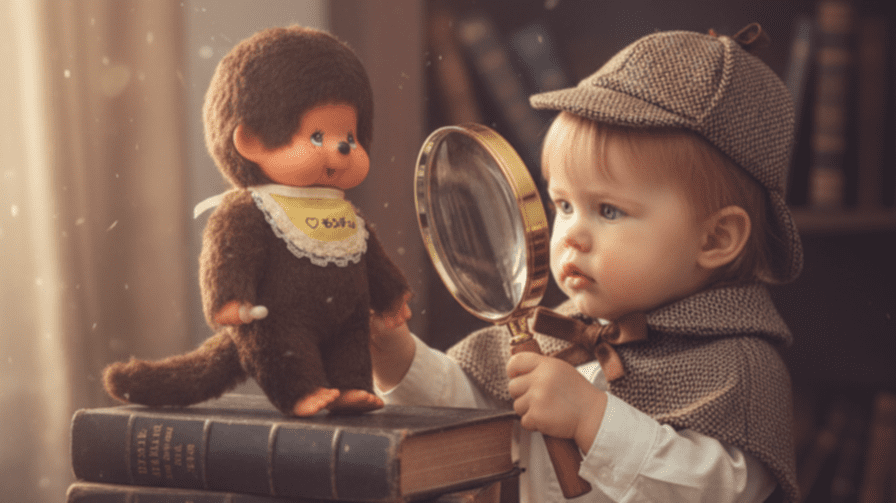
Anatomy of an Original: How to Tell a Real Monchhichi
Eyes: blue = before 1985; brown = after 1985.
Mouth: sucking a thumb = early; holding a dummy = after 1980.
Freckles: genuine dolls have four or five under each eye and three across the bridge of the nose.
Soles of the feet: no marking on the earliest dolls; later Basic Edition dolls in size S and above carry an embossed “Monchhichi” or “Sekiguchi” stamp.
Tag: the 1974 originals used green lettering; later tags are mostly black.
For any Monchhichi collector, dating a doll accurately and establishing whether it is genuine is the whole game. What follows draws together every key identifying feature into one authoritative, practical reference.
| Feature | Early Sekiguchi (1974–1979) | Mattel era (1980–1985) | Sekiguchi after 1985 |
|---|---|---|---|
| Eye colour | Blue | Blue | Brown |
| Mouth | Sucking its thumb | Sucking its thumb or holding a dummy | Holding a dummy, or closed |
| Foot marking | None | “Monchhichi” embossed stamp | “Sekiguchi” embossed stamp |
| Body tag | Fabric, green lettering | Varied; paper or fabric are both common | Fabric, black lettering |
| Fur | Matte, dark brown | Matte, dark brown | Sometimes with a sheen; various colours |
| Freckles | Four or five under each eye, three on the nose | Four or five under each eye, three on the nose | Four or five under each eye, three on the nose |
Buyer’s Guide: Spotting a Genuine Monchhichi, What It Costs and Where to Buy
Every Monchhichi at K3 Shop is imported from Japan and is 100% genuine Sekiguchi merchandise.
How Do You Tell a Genuine Monchhichi from a Fake?
| Feature | Genuine | Common giveaways of a fake |
|---|---|---|
| Freckles | Four or five under each eye, three across the bridge of the nose | Wrong number, set too low, or no freckles on the nose at all |
| Face, hands and feet | Soft vinyl with a gentle spring to it | Cheap rigid plastic that feels hard and unyielding |
| Soles of the feet | Later Basic Edition dolls in size S and above carry an embossed “Monchhichi” or “Sekiguchi” stamp | Stamp missing, or the lettering is crooked |
| Body tag | Fabric tag carrying the full product information | Tag missing, or the typeface and colours are wrong |
| Eyes (for dating) | Blue = before 1985; brown = after 1985 | — |
Want to learn how to tell the Sekiguchi and Mattel eras apart from the foot stamp, or what the tag lettering should look like? Read The Monchhichi Collector’s Handbook: A Complete Guide to Authentication and Dating.
How Much Does a Monchhichi Cost?
| Basic Edition (standard / large) | Around HK$158–458 |
|---|---|
| Animal Costume series | Around HK$278 |
| Crossover collaborations (Hello Kitty, Heidi and others) | Around HK$208–328 |
| Bebichhichi series | Around HK$128–208 |
| Seasonal and holiday limited editions | Around HK$158–268 |
Prices shown on the product page always take precedence. Browse the full Monchhichi range at K3 Shop.
Where Can You Buy a Genuine Monchhichi?
Order online: place your order directly in the Monchhichi section — free delivery on orders over HK$380.
WhatsApp enquiries: Monday to Friday, 15:30–20:00 (closed at weekends)
WhatsApp UsReturns and exchanges: if an item has a fault or does not match its stated specification, please request an exchange within seven days of the delivery date. See the K3 Shop returns and refunds policy.
Once you have authenticated your doll, check which era it belongs to against the Monchhichi milestone timeline (1972–2026).
Prices are those shown on the K3 Shop product pages.
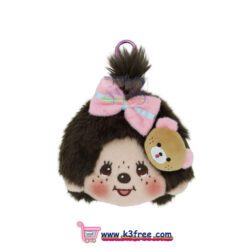
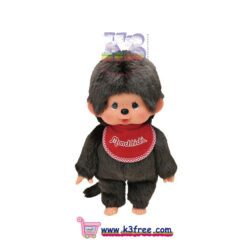
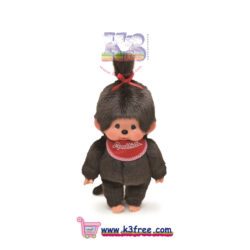
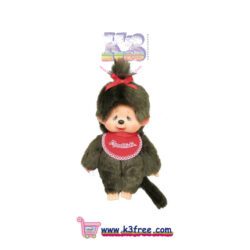
The Monchhichi Basic Edition dolls above:
The Monchhichi Grails
Rare Pieces, Limited Runs and Collaborations
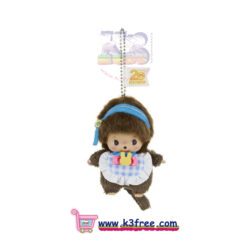
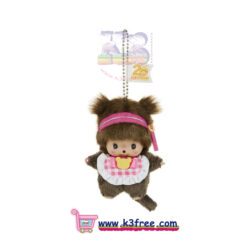
Monchhichi anniversary editions: the 30th, 35th, 40th, 45th and 50th anniversary releases, among others.
Bebichhichi anniversary editions: the 10th, 15th and 20th anniversary releases.
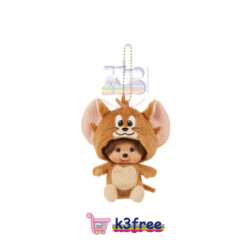
Crossover collaborations: Hello Kitty, Pochacco, Kuromi, Cinnamoroll, My Melody, Kerokerokeroppi, Heidi, Tom & Jerry, Paris Saint-Germain and more.
Themed and character limited editions: kimono, Western gowns and wedding dresses, animal costumes, character costumes, the twelve star signs, the Chinese zodiac and Halloween themes.
The Monchhichi world extends far beyond the classic brown monkey. Across more than fifty years Sekiguchi has released a dazzling number of rare, limited and collaborative editions, and these are the pieces collectors chase hardest.
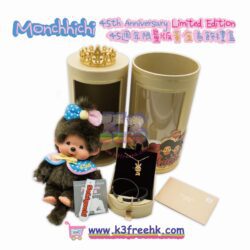
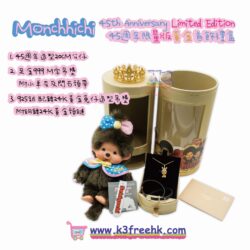
Anniversary editions: to mark its major milestones, Sekiguchi issues special commemorative releases, among them the 40th, 45th and 50th anniversary dolls. They are usually beautifully designed and hold their value exceptionally well.
Crossover collaborations: partnerships have been central to keeping the brand fresh and alive. Over the years Monchhichi has worked with a long list of well-known properties, producing a good many classics along the way — Sanrio’s Hello Kitty, Pochacco, Kuromi, Cinnamoroll, My Melody and Kerokerokeroppi; Warner Bros.’ Tom & Jerry; ZUIYO’s Heidi; Bandai Namco’s Digimon Adventure; and even the French football club Paris Saint-Germain. Each collaboration marries the Monchhichi look to another brand’s distinctive style, producing collectables that exist nowhere else.
Themed and character limited editions: the range of Monchhichi themes is close to inexhaustible. There are traditional Japanese costumes such as the kimono, and Western gowns and wedding dresses; animal costumes taking in piglets, baby elephants, pink bears, frogs, ducklings, bunnies, octopuses and penguins; occupational costumes from doctors to magicians to burger-bar staff; the twelve star signs, the Chinese zodiac, the letters A to Z and Halloween themes. Whatever you are after, it very likely exists.
Friends of Monchhichi: Monchhichi does not stand alone; its friends form a delightful little family of their own. Chimutan the bunny (チムたん), Kuma the bear (くまさん) and TanuTanu the raccoon (たぬたぬ) all have their own dolls and merchandise, filling out the Monchhichi world nicely.
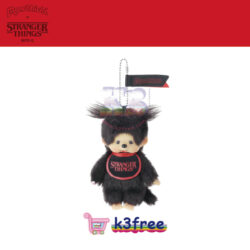
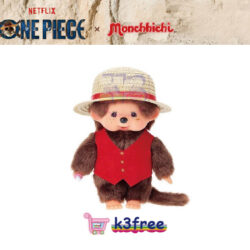
The crossover collaboration dolls mentioned above:
The anniversary editions mentioned above, still in stock:
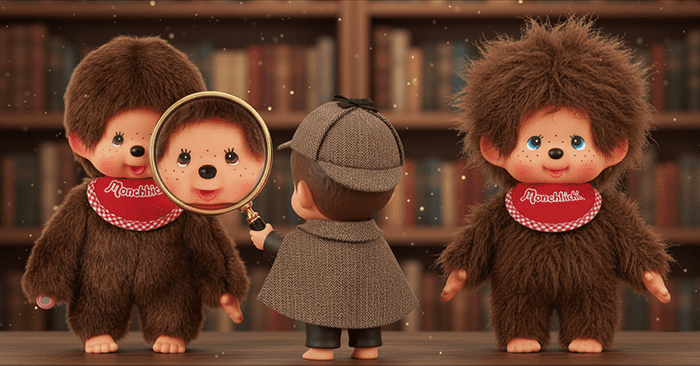
Real or Fake?
Spotting Fakes, Knock-offs and Bootlegs
The usual giveaways: freckles in the wrong place or the wrong number, badly proportioned features, cheap rigid plastic, and tags that are missing or simply wrong.
A classic anti-counterfeit measure: genuine French “Kiki” dolls were stamped “Kiki Le Vrai” (“the real Kiki”) on the sole of the foot.
At the height of Monchhichi’s popularity in the 1980s, its commercial success attracted a swarm of imitators and counterfeiters. The market filled up with unlicensed copies from East Germany, Italy, Spain and elsewhere; among the best known of the knock-offs was Spain’s “Virkiki”. For collectors, learning to separate the real from the fake is essential.
The usual giveaways of a fake:
- Misplaced freckles: far and away the most common error. On a fake the freckles often sit too low, the three on the bridge of the nose are missing altogether, or the number is simply wrong.
- Badly proportioned features: the eyes may be set too close together, or the shape of the face differs noticeably from the genuine article.
- Poor materials: a genuine doll has a face, hands and feet made of soft vinyl; many fakes use cheap, rigid plastic that feels hard and unpleasant.
- Missing or incorrect tags: fakes usually have no official tag at all, or the information, typeface and colours do not match the real thing.
- Crude finishing: vaguely moulded fingers and toes, for instance, or a dummy that will not sit properly in the mouth.
One rather charming episode in Monchhichi history: the anti-counterfeiting campaign waged by the French distributor Ajena. To fight back against the flood of fake “Kiki” dolls, they hit on the ingenious idea of stamping the sole of every genuine Kiki with the words “Kiki Le Vrai” — “the real Kiki”. It served as a guarantee of quality and as an excellent piece of brand defence, drawing a clear line between the genuine article and the copies, and protecting consumers and brand alike.